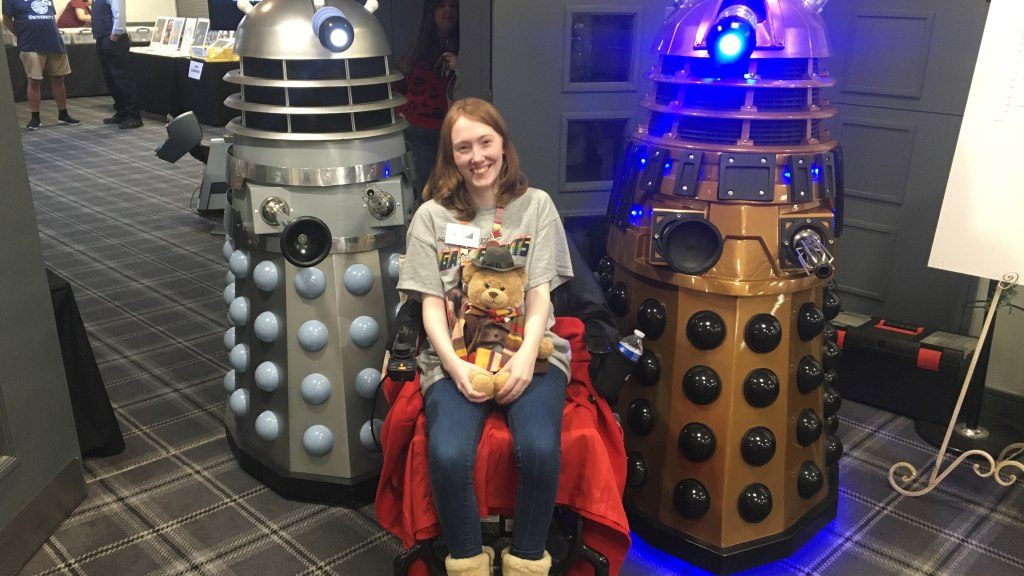
In 2022, I became a wheelchair-user.
I’m here to talk about why I decided to use a wheelchair, and to share advice for others who are considering it.
Nine years ago, I caught a viral infection. When this happens, most people are sick for a while, and then they recover. That didn’t happen to me. I was sick, but I didn’t fully recover. I was exhausted, I had frequent migraines, and I struggled to sleep. My symptoms progressed to the point where I rarely left my bedroom.
For years, I was confused. I didn’t connect the dots between my ill health and that viral infection. I saw doctors, who told me that my issues were down to my poor mental health. I tried therapy and medication. I spent two months in a psychiatric unit. Nothing helped.
Every now and then, I’d have more energy. During these periods, I’d try to continue with my education. For a few months, I’d do well… and then I would hit a wall, and I would spend the next few months rarely able to leave my bed, feeling hopeless and confused.
This became my life. Relapsing and remitting. Throwing myself into life and then crashing. Everyone told me that it was down to my mental health, so I kept trying, and I kept ‘failing’.
Then, a year and a half ago, I went to Cardiff.
Cardiff is a city that I’m very familiar with. When I was younger, I would spend hours roaming around the city. I used to walk miles with no issues. Perhaps due to this, I overestimated my physical ability.
While walking, I suddenly became very sick. My head pounded. My vision swam. I felt nauseous and dizzy. I knew that if I didn’t sit down, I would pass out. I sat on the side of the road with my head tucked down, trying to coax my body back into regular functioning.
And one thing became increasingly obvious to me at that moment.
In what universe could mental health issues cause me this pain?
After we got home, I started to do some research. Specifically, I started to read about wheelchairs. With encouragement from close friends, I took the first step towards accepting my physical situation.
When should you get a wheelchair?
Choosing to use a wheelchair is a big decision. The world is a very different place when you use a wheelchair, not to mention the cost of buying one. For me, using a wheelchair was the right decision, but it’s important for everyone to think it through carefully.
While I researched wheelchairs, one quote that I saw from a wheelchair user stuck in my head:
If your choice is between your bed and a wheelchair, pick the wheelchair.
That quote made everything come together. Anything is better than spending your life in bed. A wheelchair would be a big change, but better than the life I was living. I hoped that with a wheelchair, I could see the world again.
For me, a wheelchair was the only mobility aid that was an option. This is not everyone’s reality. It’s important to consider if another aid could better suit your needs. I’m glossing over other mobility aids as I have no experience with them, but be sure to look into them.
Testing a wheelchair
I knew that I needed help with my mobility, but I had no idea where to start. I couldn’t find information about my local NHS wheelchair service, and didn’t know how else to get a wheelchair.
Luckily, my mother had a suggestion: the Red Cross wheelchair rental service.
My local Red Cross rented wheelchairs, for free, for a period of time. Using this service, I gained access to a wheelchair that I could trial. Some Red Cross services charge for their wheelchair rental, so be sure to research your branch if you want to go down this path.
Renting a wheelchair gives you the opportunity to test it out without having to commit. It gives you a snippet of what life is like as a wheelchair-user, so you can weigh up the pros and the cons yourself. It lets you see if a wheelchair will actually be able to help you or not.
While I could see the benefits to renting a wheelchair, I was still anxious. I had heard stories of ambulatory wheelchair users being harassed, and was afraid of that happening to me.
I was also afraid of people that I knew seeing me in a wheelchair. I didn’t want them to see me differently. As well as this, I was struggling to accept the fact that I am disabled, so the idea of becoming visibly disabled was scary.
I decided to use the wheelchair while on a family holiday.
On previous family holidays, I spent most of my time in the hotel. It felt justifiable to bring the wheelchair to see if it helped. It would also quickly become clear if the wheelchair was able to help me. As an added bonus, I was so far away from home that I wouldn’t run – or roll – into anyone that I knew.
But I was still very anxious.
I spent the next weeks researching wheelchairs. I watched YouTube videos of wheelchair users. I read articles and personal accounts. I brought a weighted lap pad to help me calm myself. And then the time to go on holiday came.
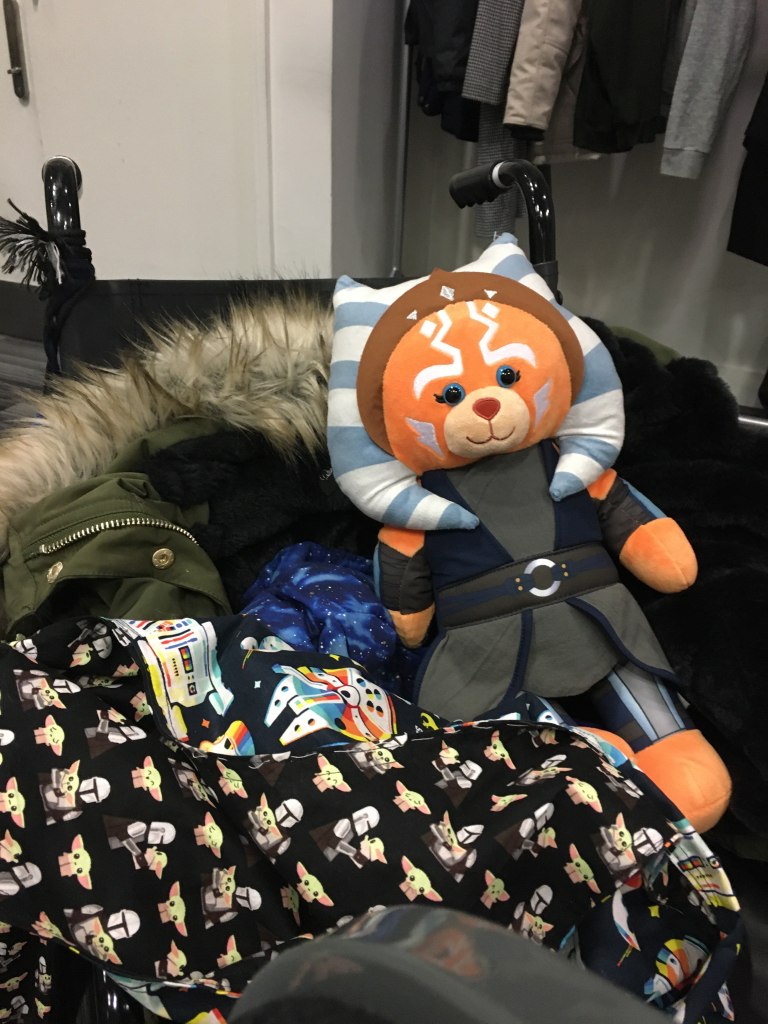
The wheelchair was a simple transit chair. I needed someone to push me. I could feel every bump. I had to be tipped backwards to get over the smallest of lips. And I loved it.
My anxiety faded fast. It was like I was seeing the world in a completely new way. Not needing to walk, I could pay attention to my surroundings. I saw squirrels running around under trees. I saw small children staring at me curiously. Everywhere I looked, I saw something interesting.
And for the first time in years, I was able to stay out all day with no consequences.
Finally, I was forced to accept that a wheelchair was a huge help to me. With it, I could keep up with my family. Just as I had hoped, I regained the ability to see the world.
Further, I was pleasantly surprised to discover that using a wheelchair wasn’t as frightening as I had feared. People were kind to me in the wheelchair. Not a single person was aggressive to me. However, I have since realised that this is in part due to ‘benevolent ableism’… but that is a conversation for another day.
This being said, I was also forced to realise just how inaccessible our world is. Even beyond steps, many shops are not equipped for wheelchairs. Doorways and aisles aren’t wide enough, and there is often merchandise blocking the way.
I could still access more of the world than my bedroom, but to my disappointment, I could not access everywhere that an able-bodied person could.
Sourcing a wheelchair
For months, I continued to use the rented wheelchair. In North Wales, I discovered the pain of using a wheelchair over cobblestones. At Star Wars Celebration, I discovered that some places do have pretty nice accessibility services.
As I became more used to the wheelchair, I started using it closer to home. Eventually, I became comfortable enough to use it in my local town and city. I bumped into people that I knew, and could tell them about my condition without anxiety. I had accepted myself as a disabled person, and no longer felt ashamed.
Gaining experience with a wheelchair also helped me to better advocate for myself when seeing my doctor. I was able to compare my experiences with and without a wheelchair, and use them to explain my health issues. I used to be afraid of how my doctors might react to me using a wheelchair, but I’ve had no issues with this.
Now, I was confident that a wheelchair could help me. I was also learning what I needed from a wheelchair. As helpful as the Red Cross chair had been, even if I had been able to keep it forever, it did not fit what I needed from a wheelchair.
What I wanted was independence and autonomy. I wanted to be able to go where I wanted to go, when I wanted to go. So a transit chair was not for me long-term.
I started to reach out to other wheelchair-users to help me to narrow down exactly what I wanted from a wheelchair. I came to a few requirements:
- It needed to be a joystick-controlled powerchair.
- It needed to be transportable.
- It needed to be able to handle some inclines and rain.
- It needed to cost between £2-5k.
With these requirements in mind, I started to search for a wheelchair. I was quickly overwhelmed by the choice. There were so many wheelchairs that fit my requirements! I struggled to tell the difference between them. I couldn’t tell what was a scam. I couldn’t tell what was reliable.
I had never spent this much money on a single purchase before. I was afraid of making the wrong decision and wasting it. I kept researching to try to find something that could help me…
And, eventually, I found it.
In a video by Pippa Stacey, she mentioned an organisation called Access Your Life. I checked their website, and was very pleased to see that they offered exactly what I needed.
After filling out their interest form, I was promptly contacted by a very nice woman. She listened to me describe my needs from a wheelchair, and gave me a list of aids that could help me. She also provided me with a supplier, who would come to my house to let me test the aids and pick what I felt suited me best.
After trying out a range of different wheelchairs, I settled for the Quickie Q50r Carbon. Mine has yellow wheels, so I named her Bessie, after the Third Doctor’s car.
Wheelchair life
Bessie arrived all in one piece.
I was nervous that she might struggle with hills or the rain, but she’s been working well for me. Every now and then she swerves to the side on an incline, but it’s nothing that I can’t control.
I was also worried that a powerchair might be too cognitively fatiguing to use long-term, but I haven’t found this to be the case. I adjusted to paying attention to my surroundings very quickly. My only issue is that I sometimes crash when trying to manoeuvre into tight spaces, but I’m sure that I will improve with this over time!
My favourite thing about having a powerchair is being able to control where I go. If I want to wander off to look at something, I can. If I want to do donuts, I can. If I want to mimic the life-sized remote-control K9 replica in front of me, I can. I don’t have to ask to be pushed to where I need to go.
My least favourite thing about having a powerchair is being limited by steps and narrow aisles. I had a moment when I realised that I could no longer enter my local Subway, because it had a thick step to get in. Bessie can handle lips better than the transit chair could, but she cannot handle any steps.
I know that places aren’t inaccessible out of malice. It isn’t that people hate disabled people. They just don’t think about us. We are an ‘other’ in society. We are confined to hospitals in people’s imaginations. They don’t realise that we want to go to all of the places that they do.
Being a wheelchair-user is realising that you now exist in an entirely different world. There are limitations to where you go. Even the way that people treat you is different. Sometimes, I use the term ‘poor dabs’ to illustrate how people see us. We’re poor, suffering babies who can’t fend for ourselves in the eyes of many – or we’re inspiring heroes overcoming our struggles. We can’t just be normal people anymore.
I found it helpful to watch wheelchair-users on YouTube when I was adjusting to my chair. Seeing other wheelchair-users living normal lives helped me to accept that I am normal. My wheelchair is normal. Being disabled is normal. People may stare or treat me strangely, but this is a normal experience of wheelchair-users.
In terms of practicality, doing anything becomes slower when you use a wheelchair. You need to plan your routes carefully to make sure that your chair can travel over them. You need to check any buildings you plan on entering to make sure that you can get inside. You need to make sure that you have a Radar Key. You need to double-check that your chair is charged enough to get you through the day.
I’ve been disabled since I was born, but it’s an entirely different experience to adjust to being visibly disabled. If you are invisibly disabled without a wheelchair, I don’t think that this is something that I can really prepare you for.
Every day, I discover something new about wheelchair life. It really does feel like I woke up one day and began existing in another world. The feeling is so difficult to describe, but if you have become a wheelchair-user, you may understand what I am talking about.
Living in a new world is exhilarating and terrifying. Everywhere you turn, there is a new experience waiting for you. It’s overwhelming, upsetting, exciting, empowering, inspiring, fury-inducing and so much more. Maybe one day I’ll work out how to put these feelings into words.
Practical help
I’ll end this blog post with some practical advice to you. This will largely be UK-oriented, but you may be able to find equivalents in other countries if you search around. These are things I have found helpful with disabled, and often wheelchair-specific, living:
- Radar Key. If you want to pee, you need this key. I was lucky enough to be gifted one by another disabled person, but seriously, make sure you have one. Many disabled toilets are locked, and you need a Radar Key to get inside.
- Access Your Life. I’ve already mentioned this organisation in this post, but I want to mention them again. They are very helpful and kind, if you’re searching for a mobility aid I strongly recommend reaching out to them. Their aid sourcing service is free. They also can assist with searching for funding opportunities to help you purchase your aid, although there is a cost to this.
- AccessAble. This website keeps a record of the accessibility of various locations. If you’re planning on going out, you can check where you’re going on here to see if it’s suited to your needs. Note that some places have more businesses added than others.
- Motability. If you are a recipient of PIP enhanced mobility rate, Motability is another option for funding your wheelchair. They have a decent range of chairs available, and the payment for using them will come from your PIP directly.
- Shopmobility. Many shopping centres are part of the Shopmobility scheme, where you can rent a mobility aid while you go about your shopping. This may be an option if you want to trial using a wheelchair without having to commit to buying one.
- SCOPE. SCOPE offers meet-ups with disabled people in a variety of areas, you can find out more information about their services on their website.
- Direct Payments. Direct Payments can be used to give you money to go towards your care. You can use Direct Payments to employ someone to function as your Personal Assistant or carer, to help increase your ability to access your community, handle your daily living requirements and live your life.
- CEA Card. A CEA Card allows a disabled person to receive a complimentary ticket when they go to the cinema, so that they may bring a carer/support person with them.
- Disabled Bus Pass. A Disabled Bus Pass entitles you to free bus services across England and Wales. Contact your local council to find out more information.
- Disabled Persons Railcard. A Disabled Persons Railcard entitles you to up to a third off rail fare.
- Many theme parks and other days out offer a reduced rate for disabled people, or a free complimentary ticket for a carer/support person. Be sure to enquire when you go!
Beyond what I have listed, there are many local and impairment-specific charities that can offer you further support and advice. I strongly recommend searching around if you’re looking for something specific. You never know what you might find!
 On a Roll